Call to Schedule Free Consultation at Over 80 Centers Worldwide!
Autoimmune
Cardiovascular
Endocrine
Gastrointestinal
Liver
Musculoskeletal
Neurological
Other
Respiratory/Pulmonary
Reproductive
Renal/Kidney
Urologic
Autoimmune
Cardiovascular
Endocrine
Gastrointestinal
Liver
Musculoskeletal
Neurological
Other
Respiratory/Pulmonary
Reproductive
Renal/Kidney
Urologic
Written by Dr. David Greene, MD, PhD, MBA on June 19, 2026
Thinking about stem cell therapy for joint pain, an autoimmune condition, or another chronic issue? Many U.S. and Canadian patients are now looking south of the border — to clinics in Tijuana, Cancun, and Puerto Vallarta — for treatment options that aren’t available at home.
This guide covers how pricing typically works, what exosomes actually are, and the regulatory facts every patient should know before booking. We’ll also reference R3 Stem Cell, one of the larger providers in this space, as a real-world example.
This article is educational only and isn’t a substitute for a conversation with a licensed physician about your specific health situation.
It comes down to regulation. The FDA generally only allows autologous treatment — your own cells, minimally processed, reinfused the same day. Once a lab grows or expands cells outside the body, the FDA treats that as a manufactured drug requiring full clinical trials. This split is formally known as 351 vs. 361 product classification.
As of 2026, the only FDA-approved stem cell products in the U.S. are cord blood-derived cells used for blood disorders like leukemia. No stem cell product is approved for orthopedic conditions such as osteoarthritis or back pain.
Mexico’s health authority, COFEPRIS, allows licensed clinics to culture and expand mesenchymal stem cells (MSCs) — usually from donated umbilical cord tissue — producing much higher cell doses than U.S. clinics can legally offer. It’s a regulated system, just a different one. See this U.S. vs. Mexico comparison for more detail.
Factor | United States | Mexico |
Cell source | Mostly your own (autologous) | Often donor-derived (allogeneic) |
Cell expansion | Not permitted outside trials | Permitted at licensed labs |
Typical dose | Lower | Higher (millions to billions) |
FDA-approved? | No, for orthopedic use | Not applicable — different agency |
Typical cost | $3,500–$25,000 | 40–80% lower |
One important clarification: a clinic licensed by COFEPRIS is not the same as “FDA-approved.” No stem cell therapy for joint or degenerative conditions is FDA-approved anywhere — in Mexico or the U.S. Be wary of any clinic that claims otherwise. Learn more about how the FDA regulates stem cells.

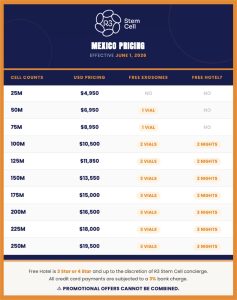
PRP is typically included free at every tier, along with ground transportation and a multivitamin.
Two quick notes:
More cells ≠ automatically better. A localized knee issue may need a smaller, targeted dose rather than a large systemic one — see how stem cell injections in Mexico are typically dosed per joint.
Compare itemized quotes, not just headline prices. Reputable clinics in Mexico generally range from $ 4,500 to $15,000 per course.
Exosomes are often thrown in as a “free bonus,” sometimes in the billions. Here’s what patients should know — see this exosome guide for more depth.
What they are: Tiny particles cells release to communicate, carrying proteins and genetic material that may aid tissue repair.
What they aren’t: FDA-approved. Zero exosome products have FDA approval as of 2026, and the agency has sent warning letters to multiple companies, including New Life Medical Services (September 2025) and Chara Biologics (January 2025), for unapproved marketing.
That doesn’t mean the science is fake — legitimate trials are ongoing. But “billions of free exosomes” should be seen as experimental, not proven. Ask what evidence supports their use. See how exosomes compare to stem cells.
Short answer: it depends on the condition, and evidence is still developing.
A 2024 Cureus study found improved pain and function in osteoarthritis patients, especially early-to-moderate cases — stem cell therapy for knee arthritis .
The 2023 MILES trial (480 patients) found no significant difference between stem cells and corticosteroid shots at one year.
Severe "bone-on-bone" arthritis generally doesn't respond well — stem cells can't rebuild lost bone or cartilage.
Bottom line: Promising for early-stage joint disease, but not a guaranteed fix or a proven cure-all.
Orthopedic — osteoarthritis, tendon/ligament injuries, degenerative disc disease .
Autoimmune — evidence varies by condition
Chronic pain — as a surgery alternative
Neurological/developmental — including autism; evidence here is limited, so be cautious
Use this clinic-selection framework as a starting point:
Licensing
COFEPRIS license on file?
Lab cGMP-certified?
Is donor tissue properly screened?
Transparency
What evidence backs this treatment for your condition?
How is "success" measured?
Who's actually administering it?
Cost
Itemized pricing?
Are "free" extras pushing you toward a bigger package than you need?
Expectations
Do they discuss limitations honestly?
Do they ever claim "FDA-approved"? (Red flag if so.)
Clinics, including R3, often cite figures like “85% satisfaction” over thousands of cases. These are typically self-reported, not peer-reviewed. Useful as a data point — not a substitute for independent evidence.
Not for orthopedic, autoimmune, or degenerative conditions. The only FDA-approved stem cell products in the U.S. are cord blood-derived cells used for certain blood disorders.
Yes, when performed at a COFEPRIS-licensed facility. Mexico has a formal regulatory framework for stem cell clinics, separate from — and generally more permissive than — the FDA’s framework.
No FDA-approved exosome products currently exist. The science is an active area of research, but exosome therapy should be considered experimental rather than an established, evidence-backed treatment.
Pricing commonly ranges from roughly $4,000 to over $19,000 depending on cell dose and included services, though some advanced protocols can run higher. Always request an itemized quote.
Stem cell therapy in Mexico offers higher doses and lower costs than equivalent U.S. options. But don’t choose based on package size or free add-ons. Ask about licensing, evidence, and transparency first — then book your consultation with clear eyes.
Contact Us
iPSCs are not the same as stem cell therapies currently in use. Mesenchymal stem cell (MSC) therapies — derived from umbilical cord tissue, bone marrow, or fat — are available now and work through anti-inflammatory signaling and immune modulation rather than direct tissue replacement.
It’s also worth understanding the difference between stem cell therapy and other regenerative approaches, and how regenerative medicine differs from traditional medicine.
R3 Stem Cell, operating across 80+ centers in eight countries, focuses on these established therapies while monitoring iPSC developments as the science matures. Learn more about what regenerative medicine is and the benefits of regenerative medicine.
Stem cell therapy for diabetes is not yet a standard of care in most countries and is generally considered investigational or complementary. Patients should review FDA regulations on cell therapies for context.
The shift in thinking began with a significant clinical study from Stanford University, published in Stroke in 2016. Researchers injected mesenchymal stem cells directly into the brains of chronic stroke patients through surgically drilled openings. The results were striking — patients who were years past their strokes showed measurable improvements in motor function, with no serious adverse events linked to the stem cells.
A follow-up phase 2b trial confirmed both the safety profile and the continued functional benefit.
The key finding was not just that patients improved — it was when they improved. These were patients well outside the traditional recovery window, which proved that the brain retains the capacity to respond to regenerative signals long after injury. To understand more about how stem cell therapy works at the biological level, it helps to look at the signaling and repair mechanisms that make these results possible.
Each of these conditions independently affects the immune system and energy regulation. Together, they create a compounding symptom profile. The most prominent symptoms Lori experienced were extreme fatigue and brain fog — cognitive difficulty sometimes described as mental cloudiness, difficulty concentrating, or slowed thinking.
These symptoms are notoriously difficult to treat through standard approaches because they often lack a single, identifiable mechanism to target. Understanding what makes the immune system attack itself helps clarify why conditions like Sjögren’s syndrome are so difficult to resolve through conventional treatment alone. As a result, many patients with complex autoimmune or post-infectious presentations explore regenerative medicine options.
DNA Mutations — The reprogramming process can introduce genetic mutations — either pre-existing or induced — that raise serious safety concerns before cells can be used in patients.
Consent alone is not sufficient. Donor mothers also undergo comprehensive medical screening, which typically includes: