Why the nose?
The brain is one of the hardest organs in the body to reach with medicine. A protective layer called the blood-brain barrier keeps most of what travels in the bloodstream out of the central nervous system. That barrier is good at its job, and it is also one of the biggest obstacles in treating neurological disease.
That is why researchers have turned their attention to an unexpected doorway: the nose. Our research team has now published two peer-reviewed papers in Frontiers journals that examine what is known about giving stem cells, exosomes, and related regenerative biologics through the nose. This post walks through what we found, from how nose-to-brain delivery works to what patients experienced in the studies.
How nose-to-brain delivery works
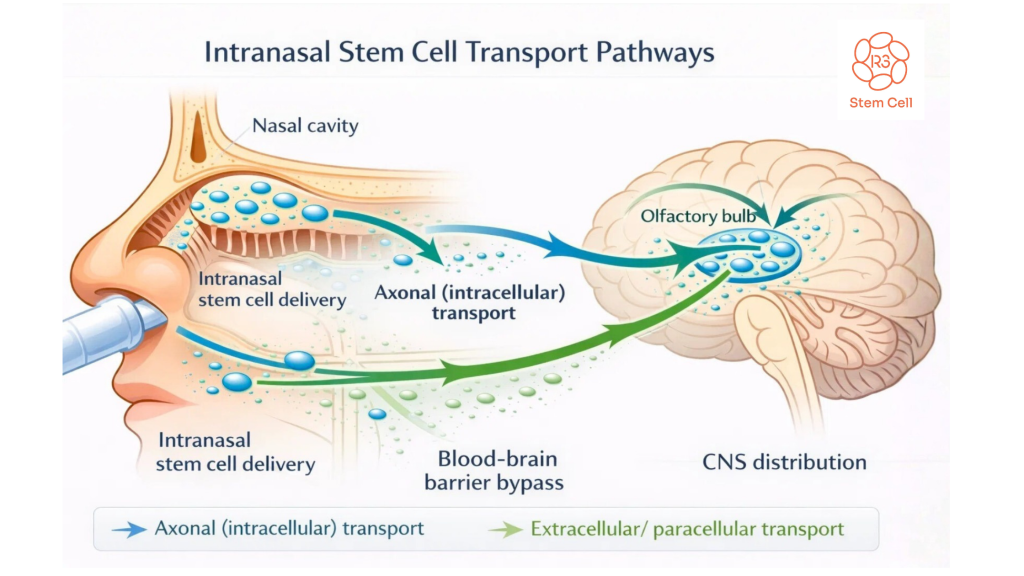
The nose offers two nerve pathways that run close to the brain, which may let a therapy skip the blood-brain barrier entirely.
- The olfactory pathway. The nerve responsible for smell connects the lining of the upper nose to the olfactory bulb and from there to the wider central nervous system. It offers a direct route along nerve fibers and the spaces around them.
- The trigeminal pathway. The trigeminal nerve supplies the lining of the nasal cavity and connects to nuclei in the brainstem, giving a second, parallel route.
Pharmacokinetic research suggests that substances applied in the nose can reach the cerebrospinal fluid within minutes. That speed points to bulk flow through the spaces around nerves, rather than slow absorption cell by cell.
Exosomes may be especially well suited to this route. These tiny vesicles measure roughly 40 to 200 nanometers, a size that may help them travel along olfactory and trigeminal pathways. Preclinical work summarized in our second paper found that intranasally delivered cells stayed at their target for 7 days to 4 months in animal models. Data on how this plays out in human patients is still limited.
Why intranasal delivery stands out
Compared with the other ways of getting regenerative biologics to the brain, the nasal route is the simplest for patients.
| Intranasal | Intravenous (IV) | Intrathecal | |
| How it is given | Drops, spray, or patch in the nose | Infusion into a vein | Injection into the spinal fluid |
| Invasiveness | Non-invasive, no needles | Needle in a vein | Lumbar puncture |
| Path to the brain | Olfactory and trigeminal nerves, bypassing the blood-brain barrier | Must cross the blood-brain barrier; much of the dose spreads through the body | Direct to spinal fluid |
| Repeat dosing | Easy to repeat | Repeatable | Each dose is a procedure |
| Suitable for children and infants | Yes, used in newborns in several studies | Yes | More difficult |
That ease of use is a big reason intranasal delivery is attractive for chronic conditions, where repeated treatments over months may be part of the plan.
What is being delivered
“Regenerative biologics” covers several very different products. Our review treats them as separate classes because they differ in what they contain, how they are made, and how they are thought to work.
- Mesenchymal stromal cells (MSCs) from bone marrow, fat tissue, or umbilical cord, which act mainly by releasing signals that calm inflammation and support repair.
- Neural stem cells (NSCs), cells committed to becoming nervous system tissue.
- Exosomes and extracellular vesicles, cell-free packets released by stem cells. They carry microRNAs such as miR-146a, which dampens inflammatory signaling, and miR-21, which helps block cell-death signals. They also carry immune-modulating molecules like TGF-β and IL-10.
- Secretome and conditioned medium, the broader mix of factors stem cells release into their growth fluid.
- Breast milk preparations, studied in premature and newborn infants. Breast milk naturally contains lactoferrin, insulin-like growth factor-1, and long-chain fatty acids that influence brain development.
Much of this mechanistic understanding comes from laboratory research, and it helps explain the signals seen in the clinical studies below.
What our systematic review found
Across 153 patients treated intranasally, no serious adverse event was judged to be caused by the treatment. That is the headline finding of our systematic review, published in Frontiers in Drug Delivery on October 16, 2026.
The review was registered in advance with PROSPERO and followed PRISMA 2020 reporting standards. We searched PubMed, Google Scholar, ClinicalTrials.gov, and China’s ChiCTR registry for human studies from January 2015 to August 2026. From more than 18,000 records, 16 publications met our criteria, covering 18 patient groups across 12 neurological conditions.
| Condition | Biologic studied | Patients treated |
| Preterm brain bleeding (GM-IVH) | Breast milk | 48 |
| Parkinson’s disease | Neural stem cells; bone marrow MSCs | 24 |
| Alzheimer’s disease | MSC exosomes; MSC secretome | 22 |
| Cerebral palsy | Neural stem cells | 15 |
| ALS | Conditioned medium; cord MSC exosomes | 15 |
| Perinatal stroke | Bone marrow MSCs | 10 |
| Newborn brain injury (HIE) | Breast milk | 10 |
| Coffin-Siris syndrome | Cord MSC exosomes | 3 |
| Autism spectrum disorder | MSC exosomes; fetal NSCs | 2 |
| Lewy body dementia | Cord MSC exosomes | 2 |
| Kennedy disease | Cord MSC exosomes | 1 |
| Congenital myasthenic syndrome | Cord MSC exosomes | 1 |
Safety. Follow-up ranged from 1 month to 39 months. When side effects occurred, they were mild and short-lived: fever, shivering, headache, brief nasal irritation, or discomfort at the application site. Thirteen of the 18 groups reported no adverse events at all.
Direction of effect. Fifteen groups reported improvement and one reported stability. No group reported worsening. In the single ALS case treated with conditioned medium, function held steady over 12 months, when gradual decline would normally be expected.
The strongest study. The only randomized controlled trial (Lv et al., 2023) gave neural stem cells to children with cerebral palsy through a patch placed at the olfactory region. It followed 24 of 25 children for two years, with blinded assessors scoring motor function.
Study highlights by condition
Alzheimer’s disease. In a phase I/II trial, 9 patients with mild to moderate Alzheimer’s received exosomes from adipose-derived MSCs by nasal spray (Xie et al., 2023). The medium dose was linked to significant improvement in cognitive scores. A second study in Japan gave MSC secretome nasal spray to 13 patients (Morita et al., 2024).
Parkinson’s disease. A phase 1 dose-escalation trial delivered human neural stem cells to 18 patients at three dose levels with no dose-limiting toxicity (Jiang et al., 2024). In another study, patients reported better mood and less daytime sleepiness within one month, and reduced depressive symptoms by three months (Boika et al., 2020).
Perinatal stroke. The PASSIoN study gave bone marrow MSCs to 10 newborns about six days after stroke (Baak et al., 2022). Its two-year follow-up, published in Stroke, reported continued safety and tracked neurodevelopment (Wagenaar et al., 2025).
Cerebral palsy. In the review’s only randomized trial, 15 children received neural stem cells through an olfactory patch and 10 served as controls (Lv et al., 2023). Motor function and daily living skills were scored by blinded assessors over 24 months.
ALS and other neuromuscular conditions. Fourteen ALS patients received umbilical cord MSC exosomes with a bilateral nasal applicator every two months, alongside smaller groups with Lewy body dementia, Kennedy disease, and congenital myasthenic syndrome (Prodromos et al., 2025). The authors reported gains in strength.
Autism. A 7.5-year-old boy with autism and seizures received MSC exosomes intranasally and was followed for 39 months, the longest follow-up in the review (Gesundheit et al., 2025). Progress was tracked with ADOS, ATEC, SRS-2, and serial EEG.
Newborn brain injury. Four studies gave fresh breast milk into the nose of premature or full-term newborns with brain bleeding or oxygen-deprivation injury. Hoban et al. (2024) showed the approach was feasible in 37 preterm infants, and Tarjanyi et al. (2026) gave twice-daily drops to 10 full-term newborns for 28 days.
Coffin-Siris syndrome. Three children with this rare genetic condition received cord MSC exosome nasal spray (Ekici et al., 2026).
How it is given: delivery methods compared
There is no standard way to deliver these therapies through the nose yet. Our review found five different techniques in use, and our paper in Frontiers in Aging Neuroscience compares their practical trade-offs.
| Method | Advantages | Limitations |
| Nasal drops by syringe | Non-invasive, repeatable, no surgery, suitable for children | Variable amount reaches the olfactory region; limited volume; not self-administered |
| Nasal patch at the olfactory region | Longer contact with the nasal lining; simple to apply | Patch can detach; no real-time dose control |
| Exosome drops in small volumes | Nano-sized carriers may bypass the blood-brain barrier | How the nose’s natural clearance affects them is still being studied |
| Nebulizers, sprays, and atomizers | Target the upper nasal cavity; allow repeated dosing | Little human data; some material may reach the lungs |
In the 153 treated patients, nasal sprays were the most common method by number of studies (6 groups). Drops or syringe delivery reached the most patients (64), mostly newborns in the breast milk studies. Because each method was tied to particular products and conditions, the review could not tell whether any one method works better than another.
Where the research goes from here
The safety record so far is encouraging, and the next step is building a larger body of controlled evidence. Most published studies to date are early-phase and small, and they used different products, doses, and outcome measures, which makes head-to-head comparison difficult. Exosome doses alone varied more than a thousandfold across studies.
No study has yet measured exactly how much of a therapy reaches the brain after nasal delivery. That data will help researchers fine-tune dosing and choose the best delivery device for each condition. In the interest of transparency, all authors of these papers work with R3 Stem Cell and its research affiliates.
What comes next
The field now needs larger, controlled trials built on shared standards. Our review lays out what those standards should cover:
- Common units for reporting dose, so studies can be compared.
- Consistent categories for recording side effects.
- The same validated outcome measures within each condition.
- Clear descriptions of the delivery device and technique.
- Measurement of how much of the therapy reaches the nasal target and, where possible, the brain.
Intranasal delivery is one of the most promising ideas in regenerative neurology because it is simple, non-invasive, and repeatable. We intend to keep leading the research that moves it forward.
Intranasal therapy at R3 Stem Cell
R3 Stem Cell offers intranasal stem cell and exosome protocols at its international Centers of Excellence, part of a network of more than 80 centers across multiple countries. Our clinical teams use the same research base summarized in these papers to guide product selection and delivery technique.
Outcomes are tracked through our IRB-approved observational safety database, so every treatment adds to the evidence the field needs. If you or a loved one is living with a neurological condition, our team can walk you through whether an intranasal protocol may be an option.
Call today +1 (844) GET-STEM or email info@r3stemcell.com to get your free consultation booked.
Sources
- Habiba UE, Sarwar I, Shamim S, Greene DL. Intranasal delivery of regenerative biologics for neurological disorders: a systematic review of clinical studies. Front. Drug Deliv. 2026;6:1969111. doi:10.3389/fddev.2026.1969111
- Habiba et al. Intranasal administration of stem cells and their derivatives for neurological and respiratory disorders. Front. Aging Neurosci. 2026. doi:10.3389/fnagi.2026.1834543
This article is for educational purposes and is not medical advice. Individual results vary. The therapies described here are not FDA-approved to treat any neurological condition.
No Comments