Call to Schedule Free Consultation at Over 80 Centers Worldwide!
Best Stem Cell Therapy in Mexico: A 2026 Patient’s Guide to Clinics, Costs, and Safety

If you are looking at stem cell therapy in Mexico, you are probably weighing two things at once: you want real treatment for a real problem, and you do not want to get burned by a clinic that overpromises. That tension is the whole reason this guide exists.

Below is a straight answer to what “best” actually means, how to check a clinic yourself, what it costs in 2026, and which clinics are worth a look. We put R3 Stem Cell Mexico at the top because of what we can document, not because we are telling you we are the only option. You should compare. This guide helps you do that.

What makes a stem cell clinic in Mexico "the best"?

The best stem cell therapy in Mexico is not defined by one clinic or one slick website. It comes down to three things: regulatory compliance, laboratory standards, and medical specialization for your specific condition.

In practice that means a clinic that operates under a valid COFEPRIS license (Mexico’s federal health authority, the rough equivalent of the FDA), sources its cells from a certified lab, and has physicians who treat your condition regularly. Most reputable centers in Mexico use mesenchymal stem cells (MSCs) from umbilical cord tissue (Wharton’s jelly) or placental tissue, which are collected after healthy, full-term births and screened before use.

Anyone can call themselves the best. The point of the rest of this guide is to show you how to check.

How to verify a clinic before you go

Before you book anything, confirm these five things in writing. A good clinic answers all of them without hesitation. Vague or evasive answers are a red flag.

1. A valid COFEPRIS license

The facility must hold a federal license to administer cellular therapies. Ask for it directly. Regulation is the single biggest difference between a legitimate medical clinic and a storefront.

2. Certified lab sourcing

The best centers use labs that follow Good Manufacturing Practice (GMP) standards or hold ISO certification. This is what keeps cell viability high and contamination risk low.

3. A Certificate of Analysis (COA)

This is a batch report for the exact cells going into your body. It shows the cell count and confirms sterility. If a clinic cannot produce one, walk away.

4. Physician credentials and involvement

Ask who is actually treating you, what their training is, and whether you will speak with that physician directly. You want a doctor with real experience in your condition, not a sales coordinator.

5. A guaranteed minimum viable cell count

Dose matters. Ask how many viable cells you are getting and how the clinic counts and confirms viability before administration.

The best stem cell clinics in Mexico (2026)

These are clinics that operate under COFEPRIS and have an established track record. We have ordered them, but the right choice depends on your condition, your budget, and where you can travel.

1. R3 Stem Cell Mexico

Locations: Tijuana, Cancún, Puerto Vallarta | stemcellmexico.com

R3 Stem Cell Mexico has treated more than 29,000 patients over the past 12 years, which is one of the larger documented patient volumes among Mexico’s stem cell providers. Treatments run across three of Mexico’s most accessible medical tourism cities, so most patients from the US and Canada have a short, direct flight option.

A few things set R3 apart for most patients:

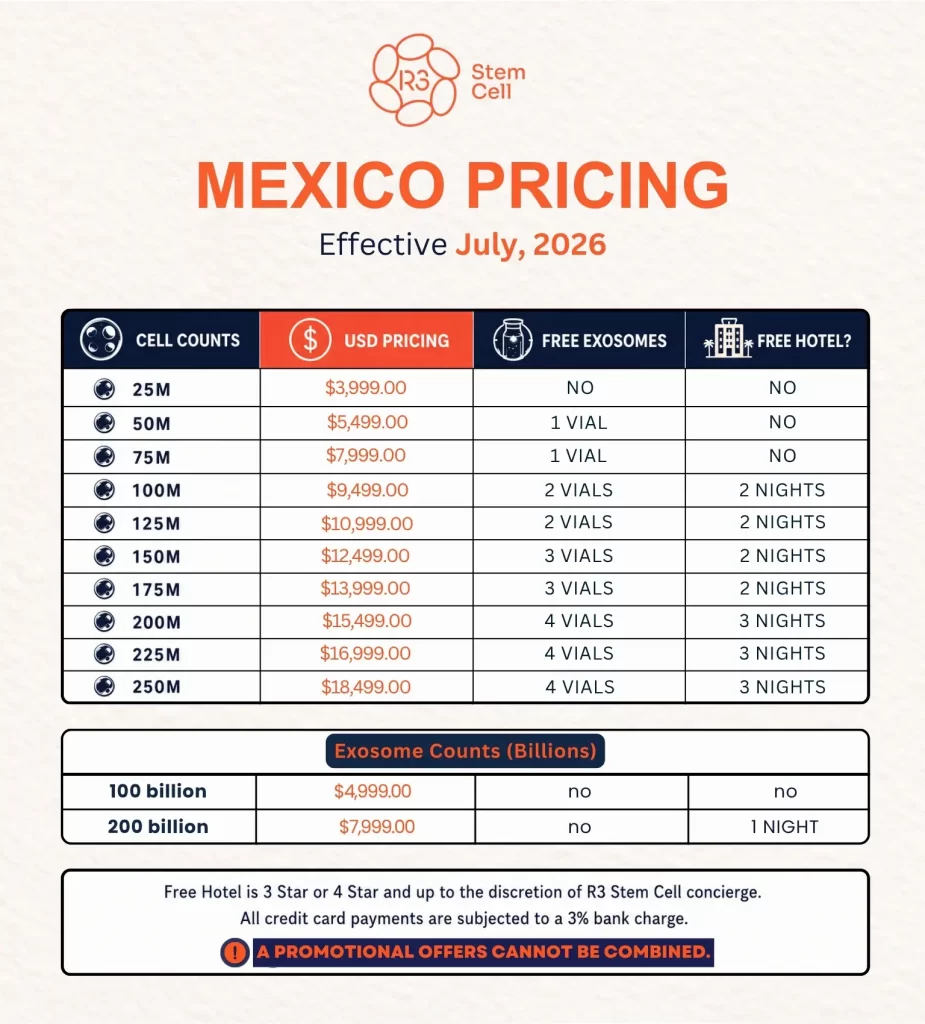
Transparent pricing. Treatments start at $3,999 for 25 million stem cells, with a price-match guarantee. Most premium clinics will not publish a number at all.

Three city options rather than one, which makes scheduling and travel easier.

Free consultation with a regenerative medicine consultant before you commit to anything.

English and Spanish patient support throughout.

R3 Stem Cell Mexico is a strong fit if you want documented experience, clear pricing, and convenient access without a luxury-resort markup.

See R3 pricing and protocols

2. Longevity Medical Institute

Location: San José del Cabo

LMI runs a vertically integrated model with an on-site ISO-6 certified lab and advanced diagnostics, including AI-assisted full-body MRI. It is a premium, concierge-style program built around extensive testing and a luxury setting. LMI does not publish pricing, and costs sit in the high range. A good option if you want a fully integrated, high-touch program and budget is not the deciding factor.

3. GIOSTAR Mexico

Location: Tijuana area

GIOSTAR is the Mexican arm of a global stem cell research network. It focuses on MSC protocols for orthopedic, autoimmune, and neurological conditions, with an in-house COFEPRIS-certified lab handling cell processing.

4. ProgenCell

Location: Tijuana

One of Tijuana’s longer-running centers, ProgenCell operates inside the NewCity Medical Plaza and treats musculoskeletal, autoimmune, metabolic, and some ocular conditions. Its location across the border from San Diego makes it easy to reach by car.

5. Regenamex

Location: Tijuana / Baja California

Regenamex concentrates on orthopedic and inflammatory conditions, using MSCs from Wharton’s jelly and placental tissue sourced through an established biotech supplier. A focused choice for joint pain and sports injuries.

6. Immunotherapy Regenerative Medicine

Location: Puerto Vallarta

A focused clinic using allogeneic MSCs for orthopedic, autoimmune, chronic pain, and anti-aging protocols, with an in-house COFEPRIS-certified lab and a fresh, non-frozen cell approach.

Quick comparison

How much does stem cell therapy cost in Mexico?

Most stem cell treatments in Mexico run between $5000 and $12,000 USD, depending on the cell dose, the number of sites treated, and the complexity of your condition. That is roughly 70–80% less than comparable treatment costs in the United States.

At R3 Stem Cell Mexico, treatments start at $3,999 for 25 million stem cells, and pricing is published up front with a price-match guarantee. Be cautious with any clinic that refuses to give you a number until after a hard-sell consultation.

Where Mexico's stem cell clinics are located

Clinics cluster in a few medical tourism hubs, mostly chosen for easy travel from the US and Canada.

Tijuana / Baja California — the largest cluster, reachable by car from San Diego. R3 Stem Cell Mexico, ProgenCell, GIOSTAR, and Regenamex all operate here.

Cancún — a major hub combining treatment with easy direct flights. R3 Stem Cell has a Cancún location.

Puerto Vallarta — a growing destination on the Pacific coast. R3 Stem Cell and Immunotherapy Regenerative Medicine treat patients here.

Los Cabos — home to premium, concierge-style facilities like Longevity Medical Institute.

What conditions does stem cell therapy treat?

This is where honesty matters most. Some uses have decent clinical evidence. Others are still investigational. A clinic that blurs that line is not protecting you.

According to research indexed on PubMed, the evidence breaks down roughly like this:

Orthopedic (knee osteoarthritis, joint and cartilage problems):
This is the strongest area. A Phase III randomized, double-blind, placebo-controlled trial of culture-expanded MSCs for knee osteoarthritis found significant pain relief and functional improvement at six months, with no serious treatment-related adverse events (DOI). A separate randomized trial using umbilical cord-derived MSCs found repeated dosing outperformed a standard hyaluronic acid injection at one year, again with no severe adverse events, though the study was small (DOI).

Autoimmune and rheumatic conditions:
A 2025 systematic review and meta-analysis of 42 randomized controlled trials (2,183 patients) reported that MSC transplantation improved symptoms in osteoarthritis, systemic lupus erythematosus, and inflammatory bowel disease, and did not increase the rate of adverse events (DOI).

Neurological conditions (MS, Parkinson’s, stroke):
Here the picture is more cautious. The same 2025 meta-analysis found MSC therapy did not significantly improve multiple sclerosis or systemic sclerosis symptoms (DOI). A 2024 review of stem cell therapy for neurological disorders described real promise but stressed that rigorous, standardized clinical trials are still needed before these uses are considered proven (DOI).

One important note: while these therapies are regulated under COFEPRIS in Mexico, many regenerative treatments are still considered investigational and are not FDA-approved in the United States. Any clinic worth trusting will tell you that plainly.

Questions to ask any clinic before you commit

Bring these to every consultation. The quality of the answers tells you as much as the answers themselves.

1. Who is my treating physician, what are their credentials, and will I be treated by them directly?

2. Where do your cells come from, and can you provide a Certificate of Analysis for my specific batch?

3. How do you count and confirm cell viability, and what is the guaranteed minimum number of viable cells I will receive?

4. Can you walk me through the full protocol and explain why this cell type and dose fit my condition?

5. Are you licensed under COFEPRIS, and what are your protocols if I have an adverse reaction?

6. What does follow-up look like, and can you share anonymized outcome data for patients with my condition?

Frequently Asked Questions (FAQ)

Yes. Stem cell therapy is legally available in Mexico through clinics licensed and regulated by COFEPRIS, the country’s federal health authority.

Is stem cell therapy safe?

Across the clinical trials above, MSC therapy was generally well tolerated, with no serious treatment-related adverse events reported in the orthopedic studies and no increase in adverse events in the autoimmune meta-analysis. Safety still depends heavily on the clinic, the cell source, and proper screening, which is why COFEPRIS licensing and a Certificate of Analysis matter so much.

Is stem cell therapy FDA-approved?

Most regenerative stem cell treatments are not FDA-approved in the US and are considered investigational. They are legally provided in Mexico under COFEPRIS regulation. This is a key reason many US and Canadian patients travel for treatment.

What's the difference between allogeneic and autologous cells?

Autologous cells come from your own body (often fat or bone marrow). Allogeneic cells come from a donor source, usually umbilical cord tissue collected after a healthy birth. R3 uses allogeneic umbilical cord-derived MSCs, which avoid a separate harvesting procedure and tend to be younger, more active cells.

How much does it cost?

Generally $3,999 to $12,000 USD depending on dose and condition. R3 treatments start at $3,999 for 25 million cells.

Ready to take the next step?

If you want clear pricing, documented experience, and treatment in Tijuana, Cancún, or Puerto Vallarta, R3 Stem Cell Mexico offers a free consultation and complimentary health review before you decide anything.

Medical disclaimer:

Special offers are for new patients, one use only. Discounts cannot be combined. Offers available while supplies last, R3 reserves the right to discontinue at its discretion.

References

Table of Contents

Dr. David Greene

MD, PhD, MBA

Dr. David Greene, MD, PhD, MBA, is a pioneering leader in regenerative medicine and healthcare marketing. As a residency and fellowship-trained orthopedic surgeon, Dr. Greene transitioned from clinical practice to become the founder and CEO of R3 Stem Cell and US Lead Network, where he has revolutionized patient care and medical practice growth through innovative therapies and digital marketing strategies. He has authored two influential books on healthcare internet marketing, ranks among the top expert authors globally, and has been featured on the cover of Corporate Vision magazine for his impact on global regenerative therapies. Beyond his professional achievements, Dr. Greene is passionate about education, compassion, and continuous innovation.